
Criminal Court Records in Macon County
A criminal court record is the court's case-level file after the prosecutor files charges. In Macon County, the Circuit Clerk maintains criminal case records for the Circuit Court system. The file can begin with a complaint, information, indictment, or other charging document and then expand through arraignment, hearings, motions, bond orders, plea activity, trial settings, disposition, sentence, and payment entries.
The Macon County Circuit Court is part of the 41st Judicial Circuit with Shelby County. Division II Criminal Law Day is listed for the first four Thursdays of each month. Felony matters, misdemeanor matters, probation issues, warrants tied to cases, and municipal or traffic criminal matters can all create court entries when filed in the circuit system. For the charge-only path after arrest, use Arrest Records & Charges; for custody status, use Inmate Records.
The Macon County Prosecuting Attorney page identifies the local charging office and prosecutor: Macon County Prosecuting Attorney.
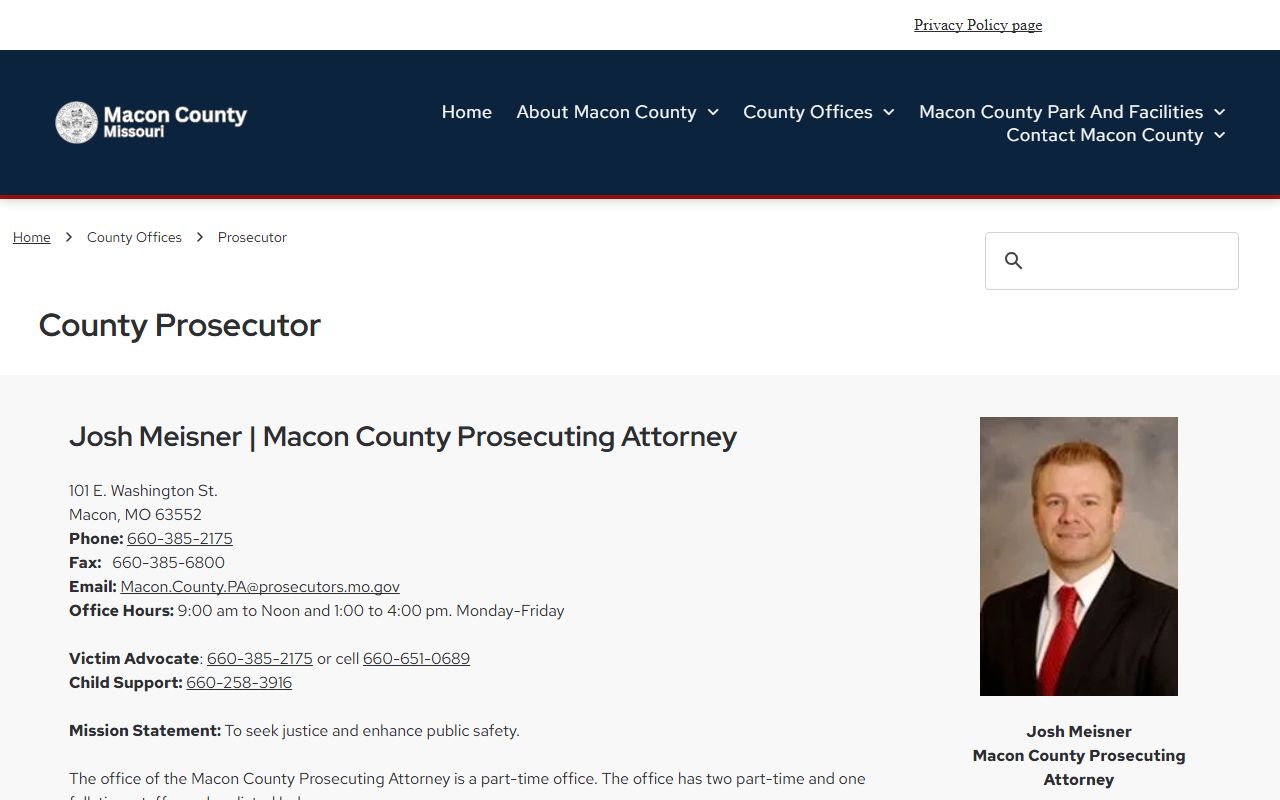
That office matters because the prosecutor files and manages the criminal charges that become part of the court record.
How to Search Macon County Criminal Court Records
Search public criminal case information through Missouri Case.net. The Macon County Circuit Clerk page says cases can be accessed by name, case number, filing date, or hearing date for cases filed on or after November 12, 2003. For pre-coverage files, certified copies, sealed-record questions, or records that are not visible online, contact the Circuit Clerk.
- Open Case.net and choose name, case number, filing date, or hearing date search.
- Search by defendant name or exact case number, using Macon County or the 41st Judicial Circuit if a filter is available.
- Open the matching criminal case and check the charges, docket entries, bond, hearings, disposition, and sentence fields.
- Compare each count separately because one case can include charges with different outcomes.
- Request certified copies from the Macon County Circuit Clerk at 101 E. Washington St., phone 660-385-4631, when official copies are needed.
A statewide criminal history search is a different product. MACHS and the Missouri State Highway Patrol criminal record check process may report conviction-based criminal history, while Case.net shows court case activity. A criminal case can appear in court records before it becomes any final conviction history.
The prosecutor's web contact form is documented at Macon County Prosecutor Contact.
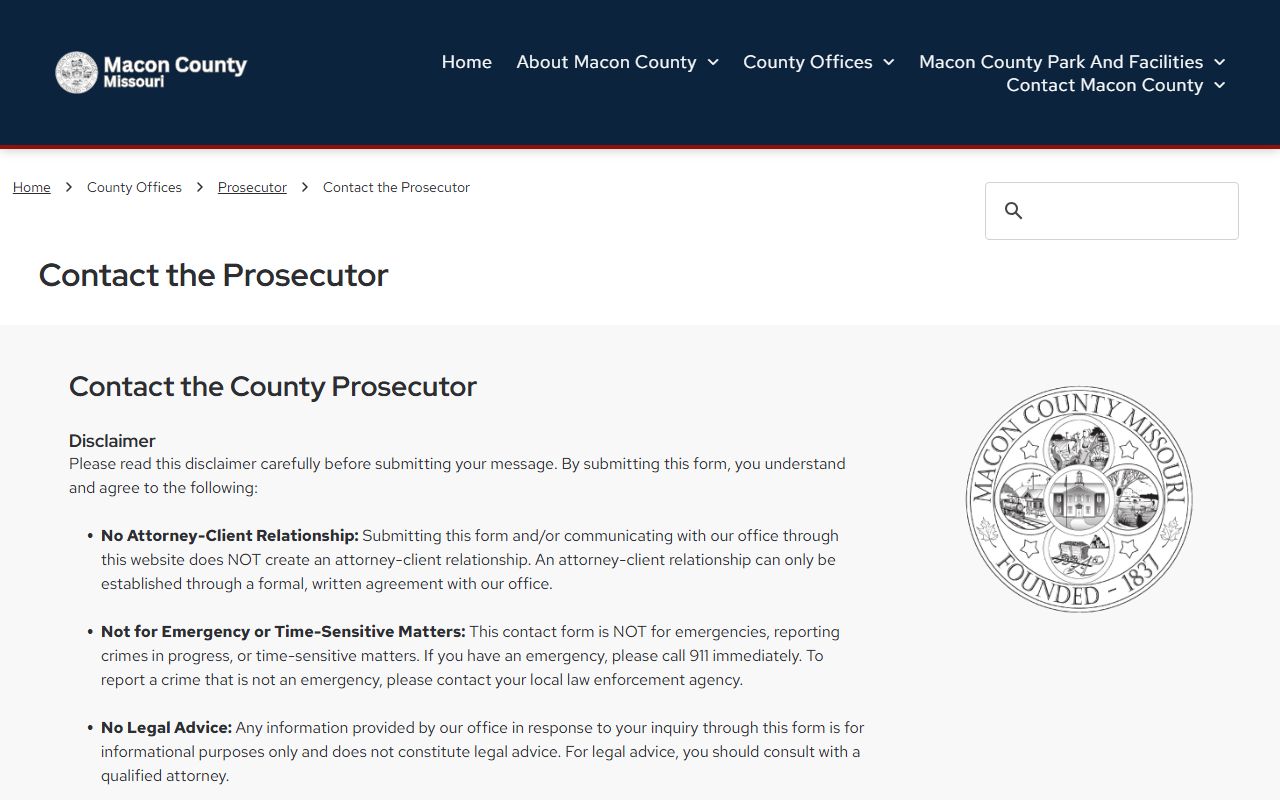
The form is not a public case search, but it shows the local prosecutor contact channel connected to criminal charging and victim services.
Stages of a Criminal Case
Criminal docket activity usually follows a sequence, although real cases can be continued, amended, dismissed, transferred, or resolved out of sequence. The docket helps track where the matter is in that path. The regular Macon County criminal law day schedule can explain why clusters of entries appear around Thursday settings.
Case flow: Arrest or investigation › charges filed › arraignment › bond and pretrial settings › motions › plea or trial › disposition › sentencing › probation, payment, or warrant follow-up.
| Stage | What Happens |
|---|---|
| Charges Filed | The prosecutor files the court-facing accusation, which may list counts, statute references, severity, and initial status. |
| Arraignment | The defendant appears, charges are addressed, and a plea or next setting may be entered. |
| Pretrial / Motions | The parties file motions, exchange information, request continuances, and prepare for plea or trial. |
| Plea or Trial | The case resolves by plea, verdict, dismissal, or other disposition. |
| Sentencing | The court imposes jail, prison, probation, fines, costs, restitution, conditions, or other orders when there is a conviction. |
What a Macon County Criminal Court Record Shows
A criminal court record is count-specific. It can show charges that remain pending, charges that were amended, charges that were dismissed, and charges that ended in conviction. Read the docket, charge table, and disposition together rather than assuming the first charge listed is the final outcome.
| Field | What It Shows |
|---|---|
| Case Number | The court identifier used for search, filings, docket lookup, and copy requests. |
| Defendant | The person charged, subject to public-access limits and redaction rules. |
| Charges | Counts, statutory references, level, amendments, dismissals, and reductions when public. |
| Bond | Release conditions, bond amounts, or custody-related orders if entered and public. |
| Plea | Guilty, not guilty, or other plea activity shown in the docket. |
| Disposition | The outcome for a case or count, such as guilty, dismissed, not guilty, or nolle prosequi. |
| Sentence | Jail, prison, probation, fines, costs, restitution, and conditions after conviction. |
| Warrants | Bench warrant, capias, or related entries when a missed court date or order creates warrant activity. |
Charges vs. Convictions
Being charged is not the same as being convicted. A charge is an accusation filed in court. A conviction requires a guilty plea, verdict, or other final finding of guilt. Macon County criminal court records can show charges that were dismissed, reduced, amended, or resulted in not guilty outcomes. That distinction is important before using any record for legal, employment, housing, or licensing decisions.
| Charge | Conviction | |
|---|---|---|
| Stage | Accusation after filing | Final guilt outcome by plea or verdict |
| Proof | Filed by prosecutor or through charging process | Requires adjudication or plea |
| Record Meaning | Shows what was alleged | Shows the count ended in guilt |
| Possible Result | Pending, amended, reduced, dismissed, or nolle prossed | May produce sentence, probation, fines, and costs |
Missouri's arrest-record expungement statute is available at RSMo 610.122.
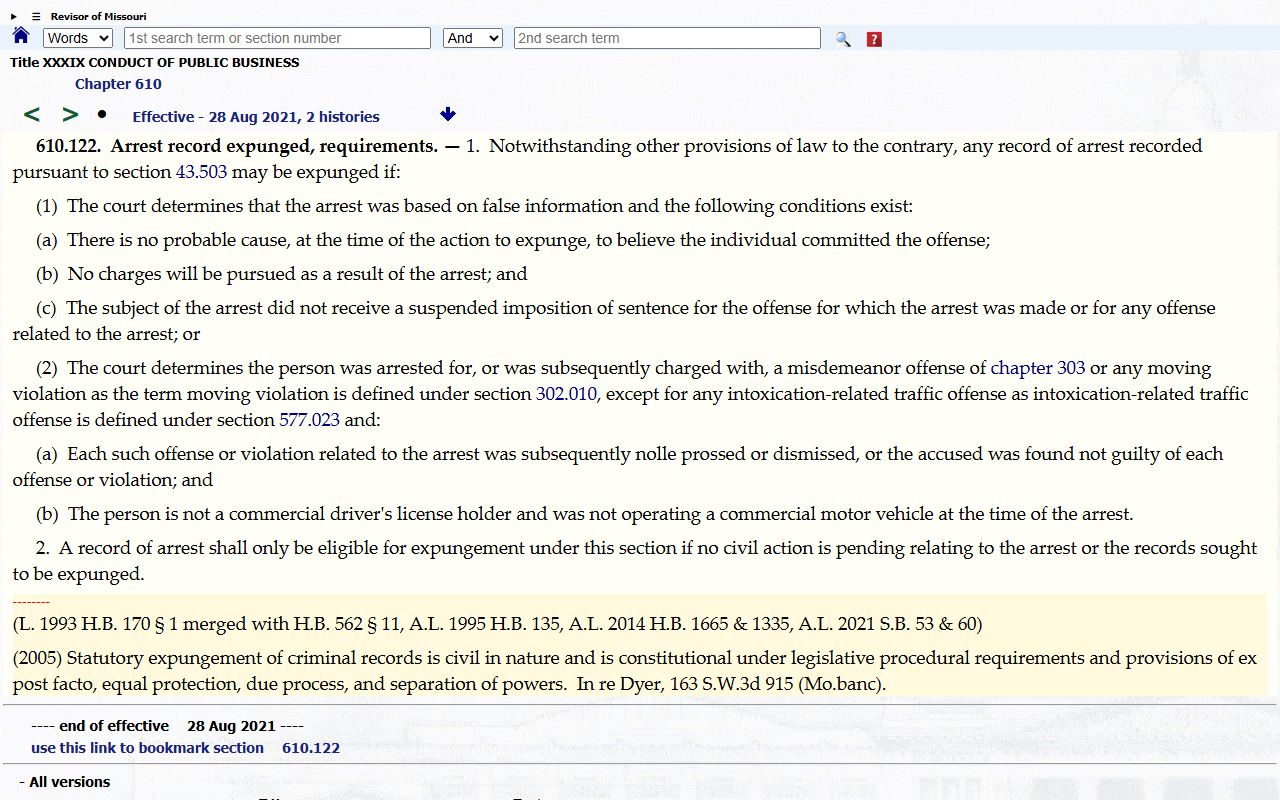
This narrower expungement route applies to certain arrest records where the tied offenses ended without conviction under the statute's conditions.
Sealed vs. Expunged Records
Missouri research distinguishes public, sealed, closed, and expunged criminal records. RSMo 610.140 governs many criminal-record expungement petitions. RSMo 610.120 says closed records are not destroyed, but they are inaccessible to the general public and to most people other than the defendant, with specific exceptions. RSMo 488.650 adds a $250 surcharge to 610.140 expungement petitions unless waived for indigency.
| Sealed / Closed | Expunged | |
|---|---|---|
| Visibility | Hidden from general public access by law, rule, or order | Closed from public view when statutory expungement is granted |
| Destroyed? | No, access is restricted | No, Missouri research says closed records are not destroyed |
| Access Afterward | Authorized agencies or court order may allow access | Criminal justice, licensing, or other authorized entities may still access under exceptions |
| Eligibility | Depends on the statute, court rule, case type, or order | Depends on waiting periods, offense limits, and petition requirements in RSMo 610.140 or 610.122 |
Missouri's criminal-record expungement statute is posted at RSMo 610.140.
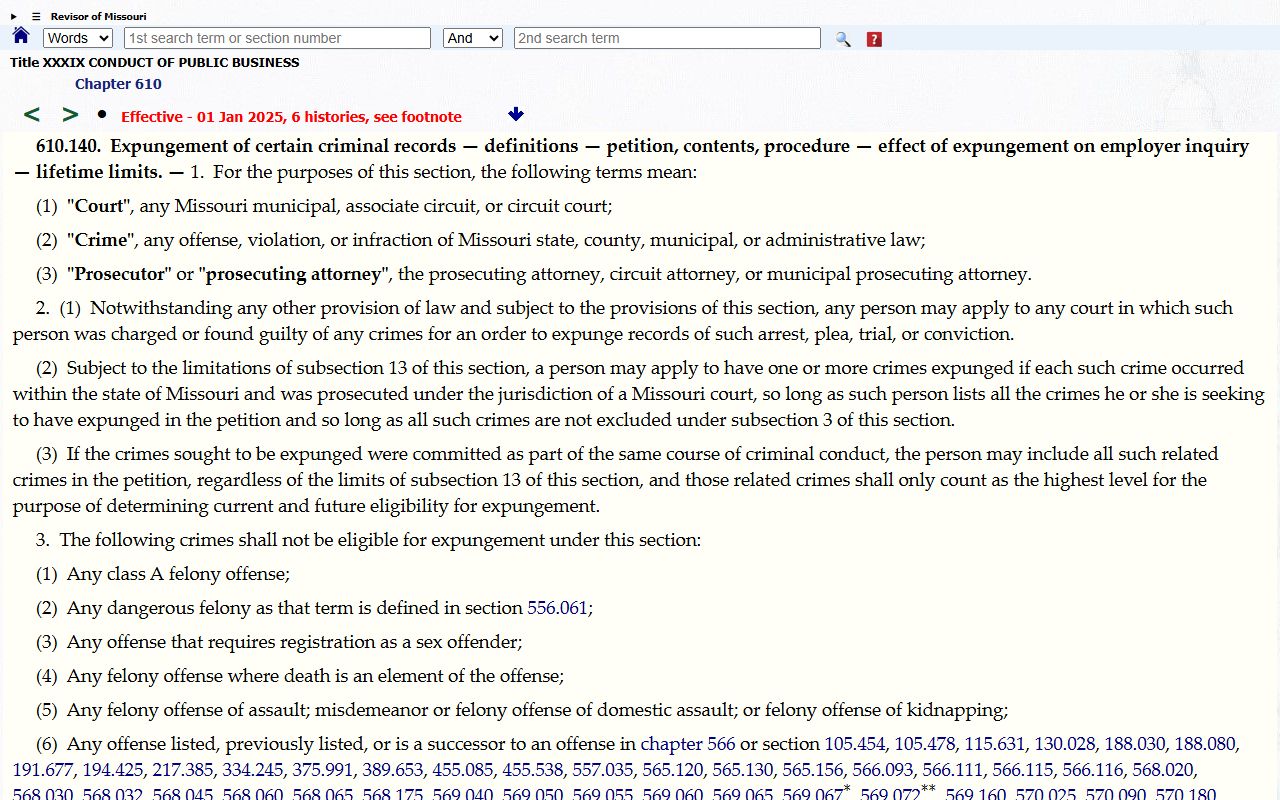
That statute is the main criminal-record expungement framework, but it does not mean every Macon County criminal case is eligible.
Closed-record access after expungement is addressed at RSMo 610.120.
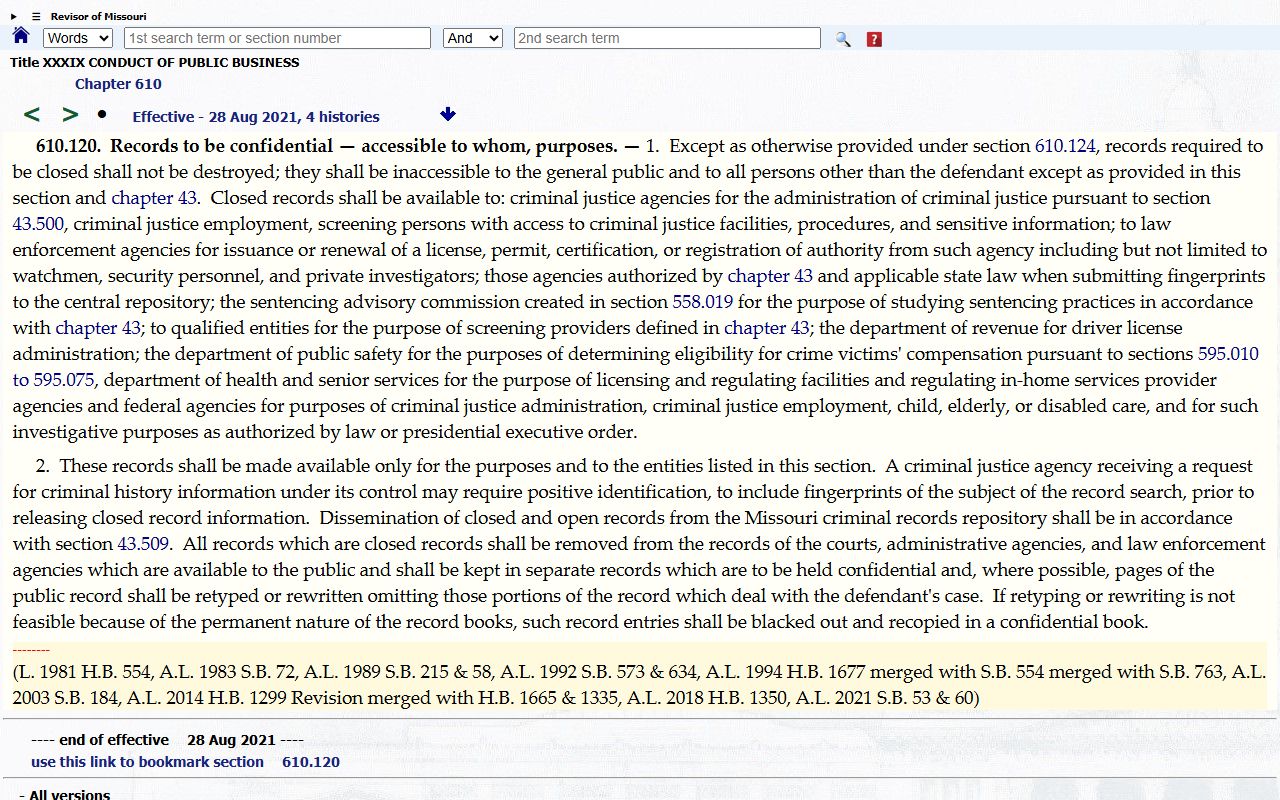
This source supports the important distinction that closed records are restricted from general public access but are not simply erased for every purpose.
The expungement surcharge statute is available at RSMo 488.650.
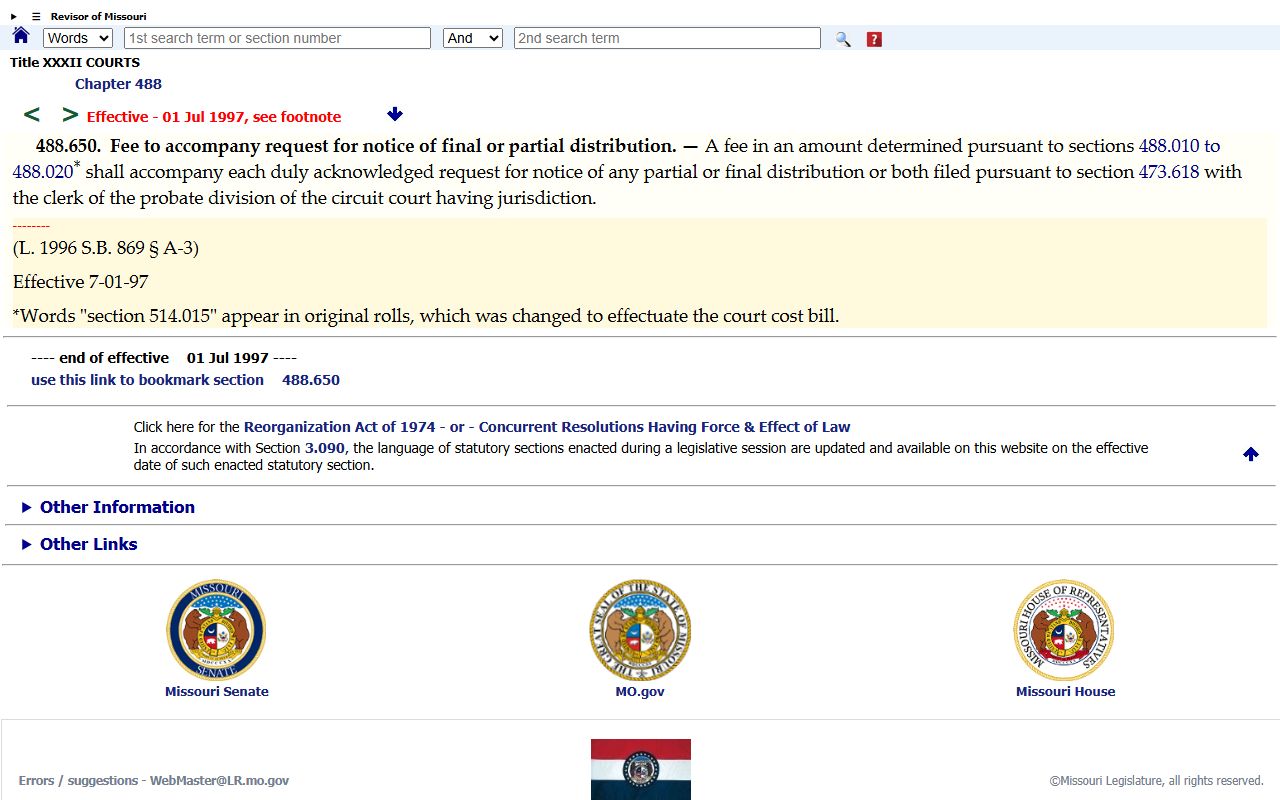
The surcharge is one reason a person seeking expungement should confirm current filing costs and waiver options with the court before filing.
Public Access to Criminal Court Records
Missouri public access starts with open-record principles, but criminal court files are controlled by court rules and confidentiality laws. Public adult criminal case information can be searched on Case.net when available. Juvenile records are restricted under RSMo 211.321 and should not be searched or described like ordinary adult criminal files. Adoption matters, some mental health matters, sealed filings, and expunged records are also restricted.
Key Statutes:
RSMo 610.011 - Missouri public records are open unless another law closes them.
RSMo 211.321 - Juvenile court records are generally confidential rather than broadly public.
Background Check Considerations
Case.net is a court-record lookup, not a consumer background report. MACHS or Missouri State Highway Patrol processes may be needed for statewide conviction-based criminal history. Employers, landlords, insurers, lenders, licensing boards, and screening companies must follow the Fair Credit Reporting Act and other applicable laws when using criminal history for regulated decisions.
Important: Do not treat casual court lookup results as an FCRA-compliant background check or as proof of a final conviction.
Restricted Criminal Court Records in Macon County
Restricted records can include juvenile referrals, sealed criminal filings, expunged records, adoption matters, confidential mental health proceedings, protected victim information, and documents with redacted identifiers. If a case exists but public search results are incomplete, the answer may be a confidentiality rule rather than a missing file. The Circuit Clerk can explain whether a public copy, certified copy, or court order is needed, but the clerk cannot release a record that law or court order closes.